20. Protein Isolation and Purification: Decoding the Molecules of Life
Attempting to understand the intricate mechanics of a high-performance engine by merely staring at a locked hood is an impossible task. Without extracting and examining the individual gears, understanding the entire system is unachievable. The core purpose of this introductory slide is to demystify Protein Isolation and Purification by laying out the essential biochemical methods required to fractionate, purify, and characterize complex biomolecules. This initial visual acts as a gateway into the analytical laboratory, setting the stage for how scientists extract functional machinery from a chaotic cellular soup.
1. Protein Isolation and Purification: The Biochemical Foundation – Unlocking the Molecules of Life
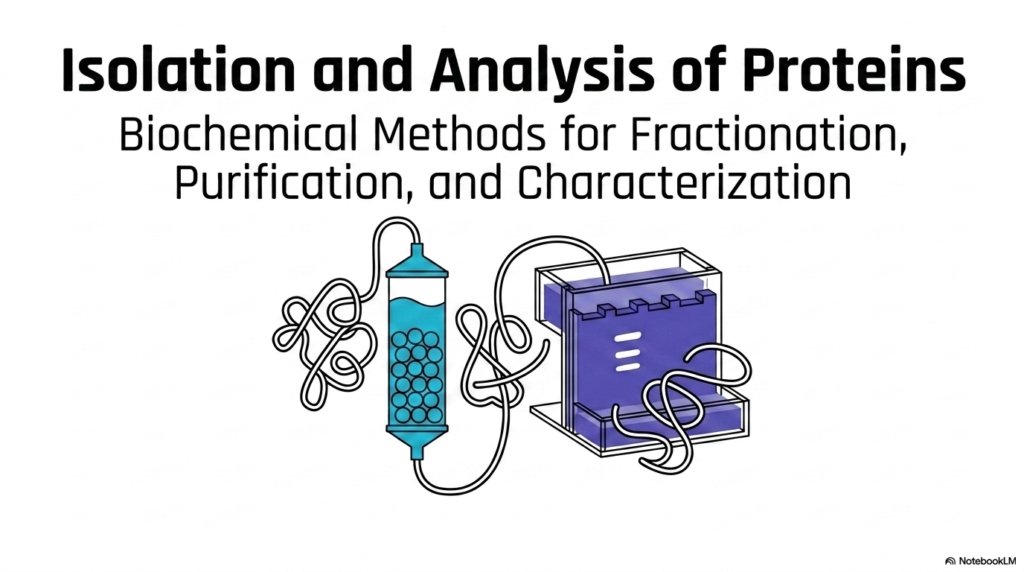
In the realm of modern biochemistry, Protein Isolation and purification remain the absolute cornerstone of both academic research and life-saving medical breakthroughs. The illustration vividly highlights two essential pieces of laboratory equipment: a sophisticated chromatography column and a highly precise electrophoresis chamber. These core tools perfectly represent the arduous journey from a convoluted, crude biological mixture to a highly refined, isolated target. The intricate web of tubing and molecular chains cleverly symbolizes the complex, tangled nature of the biological samples researchers handle daily.
Fractionation, purification, and characterization are never just random laboratory tasks; they form a carefully choreographed sequence of scientific events. When researchers embark on a Protein Isolation and Purification pipeline, they systematically utilize specific physicochemical properties to their distinct advantage. The chromatography column actively relies on the mobile and stationary phases to separate molecules based on their inherent physical properties. Meanwhile, the gel electrophoresis chamber uses an electric current to pull molecules through a physical, restrictive matrix.
Mastering these foundational concepts is absolutely vital for ambitious college and medical students. Without a solid, working grasp of these preparative techniques, advanced studies in proteomics, enzymology, and targeted drug development would remain entirely inaccessible. By meticulously separating these intricate molecular machines, researchers can finally begin to analyze their specific functional roles in human health, chronic disease, and fundamental cellular biology.
2. Protein Isolation and Purification: Exploiting Physicochemical Properties – Overcoming the Proteome Challenge
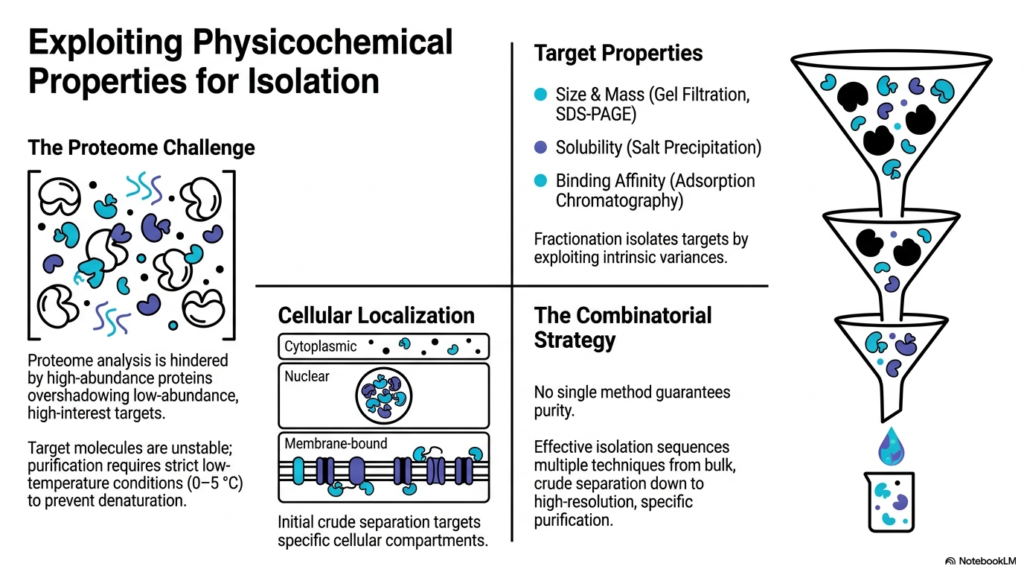
Every living cell is incredibly crowded, functioning much like a bustling metropolitan city during the chaotic heights of rush hour. Finding one specific molecule in this intense biochemical chaos is incredibly daunting. The core purpose of this slide is to explain in detail how researchers design a strategic Protein Isolation and Purification workflow that leverages intrinsic physicochemical differences. It visually breaks down the immense “proteome challenge,” where high-abundance background molecules completely overshadow low-abundance, high-interest targets.
To achieve successful Protein Isolation and Purification, scientists must identify specific target properties that uniquely identify their molecule. The slide categorizes these exploitable traits into size and mass, solubility, and specific binding affinity. By intentionally targeting size via gel filtration, solubility via aggressive salt precipitation, or binding affinity via adsorption chromatography, researchers can force the target to behave differently from contaminants. This highly tailored approach is exactly what makes biochemical separation so powerfully precise.
Before applying these complex high-resolution techniques, initial crude separation often targets specific cellular compartments. The diagram beautifully illustrates proteins residing securely in the cytoplasm or the nucleus, or tightly embedded in the cellular membrane. By successfully lysing cells and using differential centrifugation, researchers can isolate their target of interest’s specific cellular localization. Furthermore, the target molecules are inherently unstable, necessitating strict low-temperature conditions to prevent thermal denaturation during rigorous extraction.
The most critical takeaway for students studying Protein Isolation and Purification is the combinatorial strategy shown on the right side of the slide. Absolutely no single method guarantees complete purity in a single step. The funnel graphic powerfully visualizes how effective isolation fundamentally requires carefully sequencing multiple, distinct techniques. Scientists must continuously move from bulk, crude separation steps down to high-resolution, highly specific purification methods, slowly filtering away unwanted background noise until the pure target remains.
3. Protein Isolation and Purification: Modulating Solubility via Ionic Strength – The Science of Salting Out
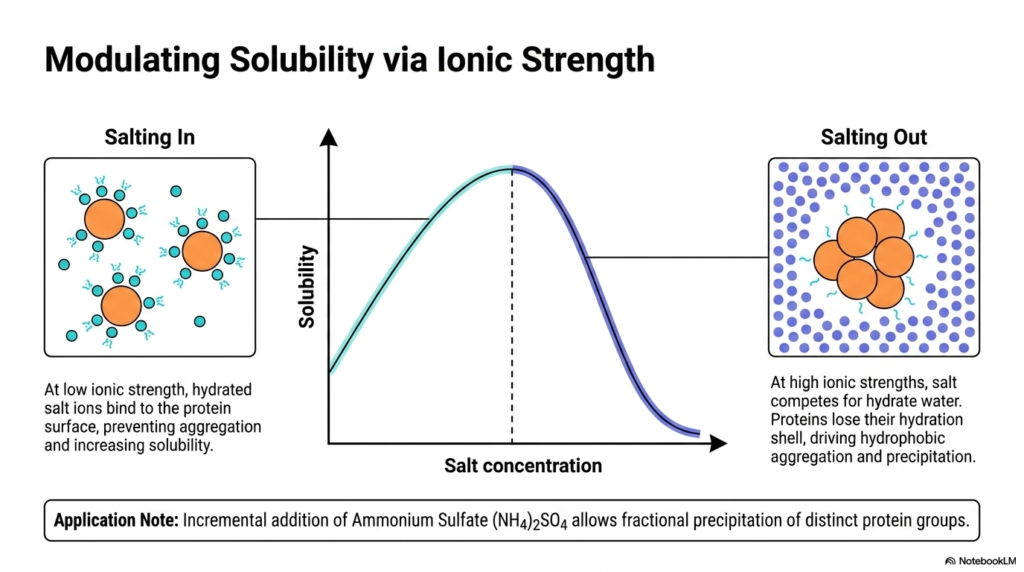
Observing the simple addition of table salt to water reveals dramatic changes in basic physical properties, including the boiling point. In complex biochemistry, salt does something even more spectacular to massive macromolecules. The core purpose of this slide is to explore how modulating ionic strength drives one of the oldest and most reliable preliminary steps in Protein Isolation and Purification. By carefully manipulating precise salt concentrations, researchers can selectively induce specific molecules to precipitate from a chaotic solution.
The biochemical concept strictly begins with “Salting In” at lower ionic strengths. When a small amount of salt is introduced, the hydrated salt ions actively bind to the protein’s outer surface. This critical interaction effectively masks the protein’s surface charges, preventing unwanted aggregation and actually increasing the molecule’s overall solubility in the surrounding solvent. For students mastering Protein Isolation and Purification, understanding this stabilizing effect is crucial, as it successfully keeps the target safely dissolved during the earliest extraction phases.
However, the true biochemical magic happens during “Salting Out.” As salt concentration increases drastically, highly abundant salt ions aggressively compete with proteins for available water. The proteins subsequently lose their vital, protective hydration shell. Stripped completely of this water layer, the dangerously exposed hydrophobic regions of the proteins violently interact with one another, driving massive hydrophobic aggregation and subsequent precipitation. The provided graph clearly illustrates the bell-shaped relationship between salt concentration and overall solubility.
This fundamental mechanism acts as a brilliant, completely non-destructive tool for any rigorous Protein Isolation and Purification protocol. The application note specifically highlights Ammonium Sulfate as the absolute gold standard for this laboratory technique. Because different molecular groups possess distinct hydrophobic surface areas, incremental, highly controlled additions of Ammonium Sulfate enable the selective precipitation of specific target groups, serving as an excellent preliminary purification step.
4. Protein Isolation and Purification: Buffer Exchange and Contaminant Removal – The Mechanics of Dialysis
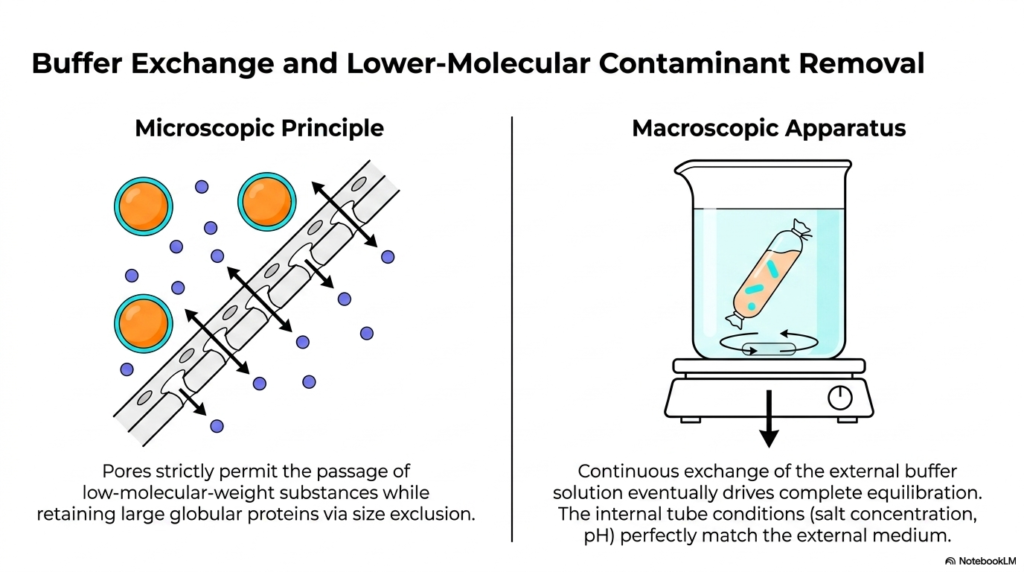
Consider the slow process of cleaning a delicate, highly porous sponge by soaking it in fresh water until all the internal soapy residue completely diffuses away. Dialysis strictly relies on a remarkably similar, entirely passive process to gently cleanse microscopic biological samples. The core purpose of this slide is to detail how researchers reliably remove lower-molecular-weight contaminants and exchange harsh buffers during Protein Isolation and Purification. It visually contrasts the microscopic principles of semipermeable membranes with the macroscopic laboratory apparatus.
At the microscopic level, the strict physical principle of size exclusion governs the entire equilibration process. The specialized membrane features incredibly precise pores that freely permit the passage of tiny, low-molecular-weight substances, such as remnant salts from a previous heavy precipitation step. Simultaneously, these exact same tiny pores retain the large, bulky globular proteins safely inside the protective casing. This fundamental mechanism is widely used in Protein Isolation and Purification to gently remove unwanted small molecules without damaging fragile, high-value targets.
Looking directly at the macroscopic apparatus, the laboratory setup is elegantly simple yet functionally brilliant. A sealed, semipermeable tube containing the crude, contaminated sample is completely submerged in a massive beaker of fresh external buffer solution. A magnetic stirrer ensures the continuous, dynamic exchange of the external buffer, which eventually drives the entire closed system toward complete chemical equilibration. The internal tube conditions, including critical factors such as salt concentration and precise pH, will ultimately match those of the external medium perfectly.
For medical and college students actively designing a modern Protein Isolation and Purification workflow, dialysis is often the absolutely vital bridge between crude fractionation and high-resolution chromatography. By definitively ensuring the biological sample is perfectly suspended in the exact right buffer and completely free of interfering salts, researchers brilliantly set the stage for highly successful downstream applications. It perfectly demonstrates the beautiful predictability of passive diffusion.
5. Protein Isolation and Purification: Chromatographic Separation – Navigating Hydrodynamic Volume
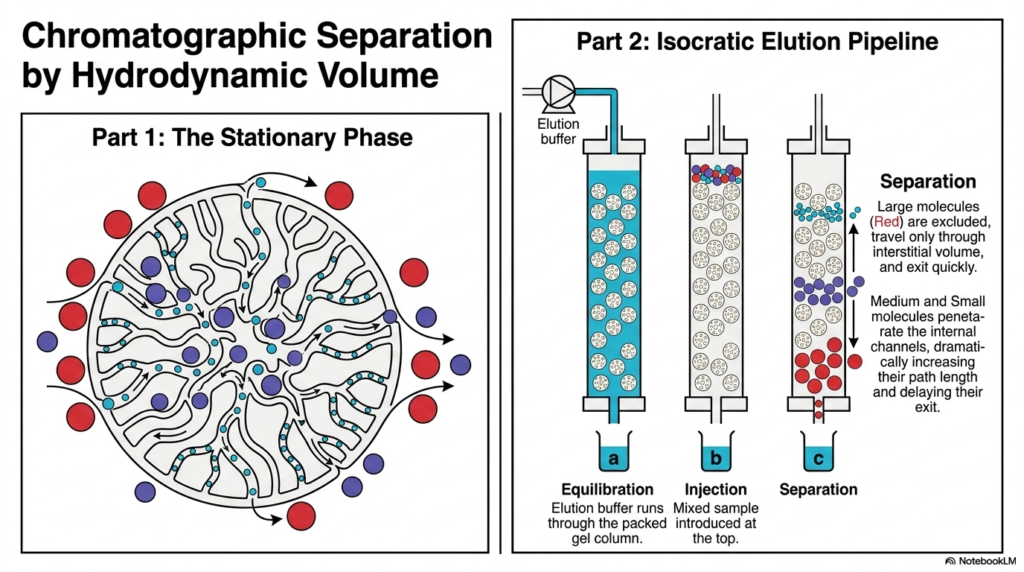
Think of an intricate obstacle course where small competitors must crawl through a dense labyrinth of tiny, winding tunnels, while massive competitors simply walk straight past the structure directly to the finish line. Size-exclusion chromatography operates on the exact same physical principle. The core purpose of this slide is to explain the mechanics of separating molecules by hydrodynamic volume, an absolutely crucial high-resolution technique widely used in advanced Protein Isolation and Purification pipelines.
Part one of the visual specifically highlights the microscopic stationary phase, which consists of highly engineered, densely porous beads. The separation mechanism is beautifully counterintuitive: massive molecules, prominently represented in red, are completely physically excluded from the tiny internal pores. Because they cannot physically enter the labyrinth, they travel exclusively through the empty interstitial volume between the beads and subsequently exit the column very quickly. This size-dependent routing is a non-destructive cornerstone of Protein Isolation and Purification.
Conversely, the medium and small biological molecules, shown in purple and blue, are small enough to actively penetrate the winding internal channels of the stationary phase. This dramatic physical diversion significantly increases their overall path length as they travel through the column, substantially delaying their final exit. The smaller the molecule, the deeper it penetrates the porous matrix, and the longer it takes to elute. This differential migration creates the distinct separation bands required for precise Protein Isolation and Purification.
Part two of the slide sequentially illustrates the macroscopic isocratic elution pipeline, seamlessly moving from initial equilibration to final, high-resolution separation. The elution buffer runs continuously downward through the heavily packed gel column, safely carrying the mixed biological sample introduced at the top. As the sample travels downward, the physical sieving effect beautifully resolves the mixture into distinct, completely purified fractions. Grasping this hydrodynamic separation is an absolute requirement for biochemistry students.
6. Protein Isolation and Purification: Interpreting SEC Elution Profiles – Decoding Molecular Mass
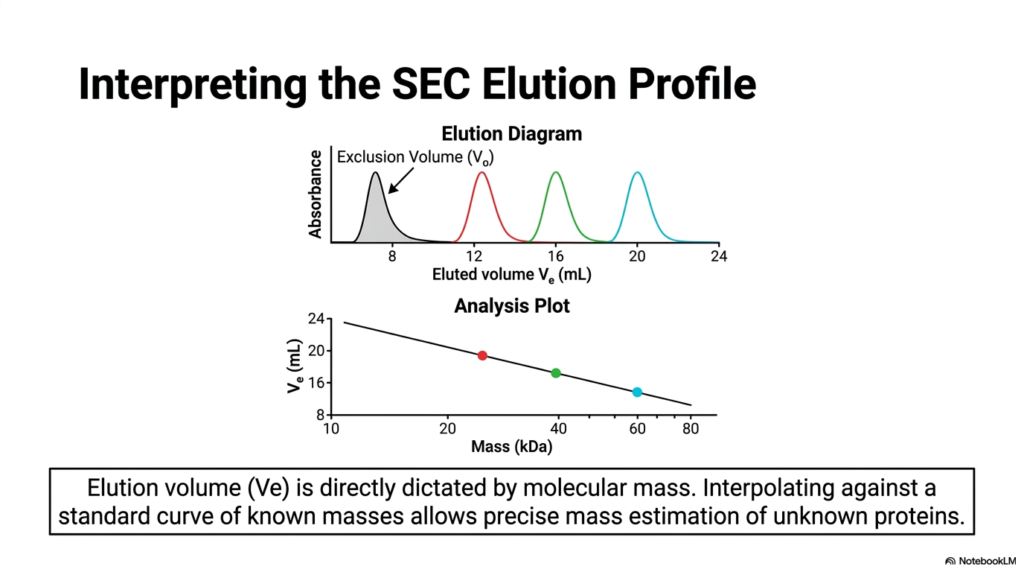
If a sophisticated chromatography column acts as a physical racetrack, the resulting elution profile is the high-tech scoreboard that tracks exactly when each molecular runner crosses the finish line. The core purpose of this slide is to meticulously teach students how to mathematically interpret data generated specifically during Size Exclusion Chromatography. In the broader, exacting context of Protein Isolation and Purification, merely collecting fractions is totally insufficient; researchers must accurately analyze the resulting chromatogram to guarantee success.
The top elution diagram carefully plots ultraviolet absorbance against the total eluted volume. The very first massive peak to physically appear strictly represents the exclusion volume, which contains all the massive molecules that were completely excluded from the porous matrix. Following this initial peak, distinct bands emerge for successively smaller and smaller molecules. Analyzing this visual readout is a routine, daily task in any Protein Isolation and Purification laboratory, providing critical, immediate feedback on the run’s exact resolution.
The lower analysis plot brilliantly reveals the strict mathematical predictability of this highly controlled biochemical technique. There is a beautifully strict, inversely proportional mathematical relationship between a specific molecule’s overall mass and its final elution volume. By meticulously graphing this exact relationship on a standard curve utilizing known molecular weights, researchers unlock a powerful analytical tool. This robust mathematical predictability transforms SEC from a mere preparative step into a highly rigorous analytical method within the Protein Isolation and Purification workflow.
For serious biochemistry students, the ultimate conceptual takeaway is the immense power of interpolation. If a researcher runs an entirely unknown sample directly through the SEC column and carefully notes its exact elution volume, they can seamlessly map that specific volume directly onto the established standard curve. This allows for the highly precise mass estimation of entirely unknown proteins, brilliantly bridging the critical gap between empirical laboratory observation and rigorous quantitative analysis.
7. Protein Isolation and Purification: SEC Modalities – Group Separation vs. High-Resolution Fractionation
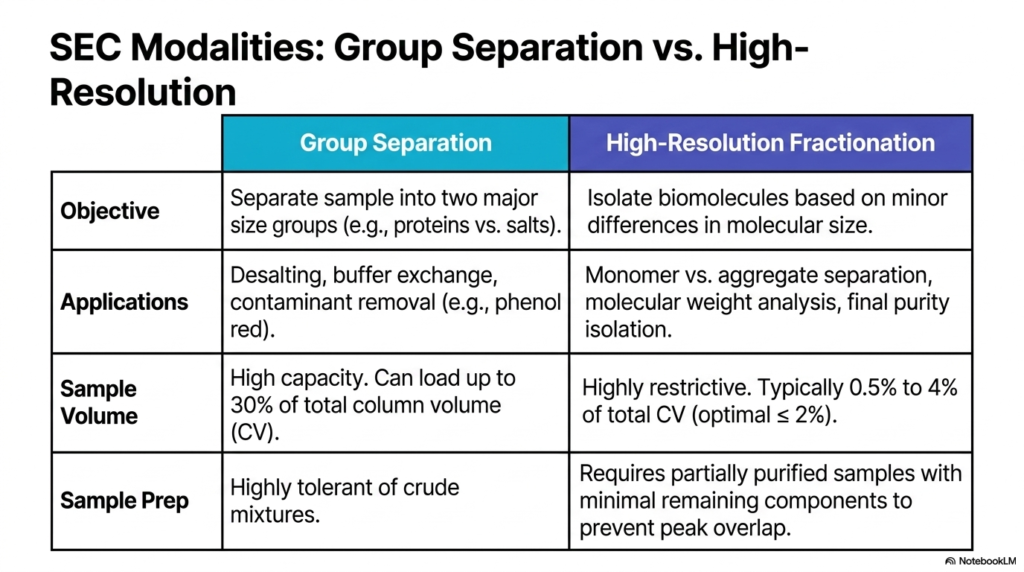
Deploying a massive snowplow rapidly clears a frozen highway, while using a tiny, delicate brush slowly uncovers a fragile fossil. Both definitely move physical material, but their absolute precision and core objectives are vastly different. The core purpose of this slide is to meticulously contrast the two primary modalities of Size Exclusion Chromatography. Understanding exactly when to deploy robust group separation versus delicate high-resolution fractionation is a critical decision-making skill in any modern Protein Isolation and Purification strategy.
Group separation actively acts as the robust biochemical snowplow. Its primary, unyielding objective is to rapidly separate a complex sample into two major, vastly different-sized groups, such as large functional macromolecules versus tiny, unwanted salts. This specific modality boasts an incredibly high sample capacity, reliably allowing researchers to load up to 30% of the total column volume. In a comprehensive Protein Isolation and Purification protocol, this method is heavily utilized for rapid desalting and aggressive contaminant removal.
In stark contrast, high-resolution fractionation strictly acts as a delicate, highly precise brush. Its sole objective is to beautifully isolate functional biomolecules based on incredibly minor, highly nuanced differences in exact molecular size. Because it requires such high precision, the overall sample volume is strictly limited to 4% of the total column volume. Mastering this delicate physical balance of load capacity and resolution defines true expertise in Protein Isolation and Purification.
Furthermore, the initial sample preparation requirements entirely dictate which specific modality can be successfully used. Group separation is highly tolerant of messy, visually crude biological mixtures straight out of the preliminary centrifuge. High-resolution fractionation, however, absolutely demands highly purified samples with minimal remaining background components to actively prevent catastrophic peak overlap. By intelligently sequencing these two distinct modalities, students can successfully construct incredibly powerful biochemical workflows.
8. Protein Isolation and Purification: Optimizing Matrix Choice – Targeting the Sweet Spot
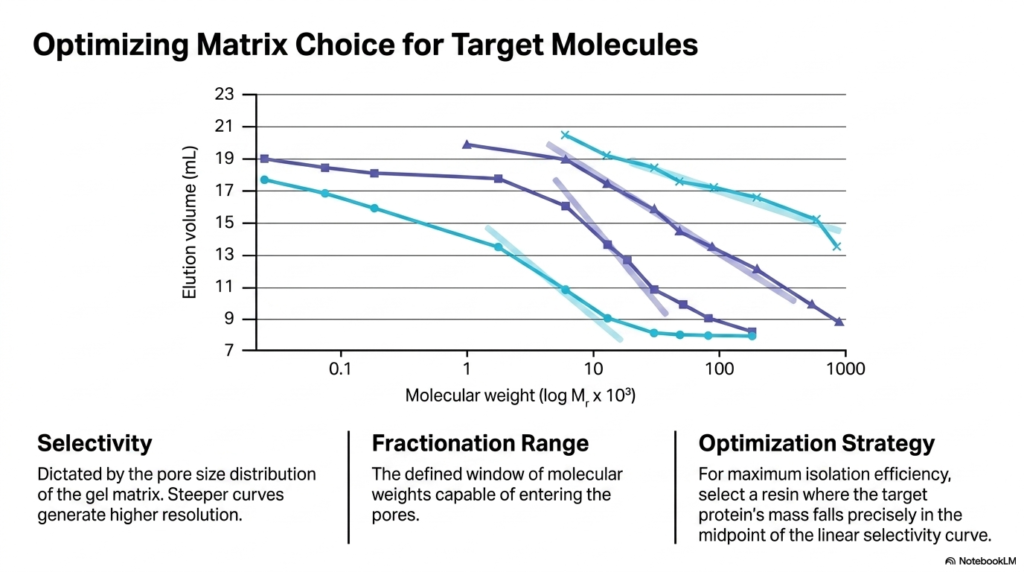
Choosing the entirely wrong chromatography resin is like trying to use a massive, wide-mesh fishing net to catch microscopic aquatic plankton; the physical tool must perfectly match the target. The core purpose of this slide is to powerfully illustrate the critical importance of actively optimizing the choice of matrix for specific target molecules. In the exacting, highly precise field of Protein Isolation and Purification, selecting the mathematically correct gel matrix is the single most important operational variable.
The detailed logarithmic graph precisely displays multiple linear selectivity curves, with each line representing a distinct commercially available gel matrix. These distinct mathematical curves are strictly dictated by the unique, highly engineered pore-size distribution built into the resin beads. Steeper curves on the graph actively generate significantly higher spatial resolution, completely separating delicate molecules with remarkably similar masses. Understanding these fractionation ranges is completely mandatory for any successful Protein Isolation and Purification endeavor.
The strict fractionation range fundamentally defines the exact mathematical window of molecular weights absolutely capable of successfully entering the tiny matrix pores. If a target molecule falls outside this specific range, it will either be physically excluded or functionally trapped, resulting in an absolute zero separation. When designing a rigorous Protein Isolation and Purification protocol, researchers must meticulously analyze their target protein’s predicted mass to ensure complete analytical success.
The ultimate, highly successful optimization strategy deeply relies on perfect geometric precision. For maximum overall isolation efficiency, brilliant students and researchers must select a resin for which the target protein’s exact mass lies at the midpoint of the linear selectivity curve. This highly strategic positioning provides the maximum possible spatial separation from both larger and smaller contaminating molecules, ensuring that the final fraction in the Protein Isolation and Purification pipeline is exceptionally pure.
9. Protein Isolation and Purification: Dictating Chromatographic Resolution – Controlling the Variables
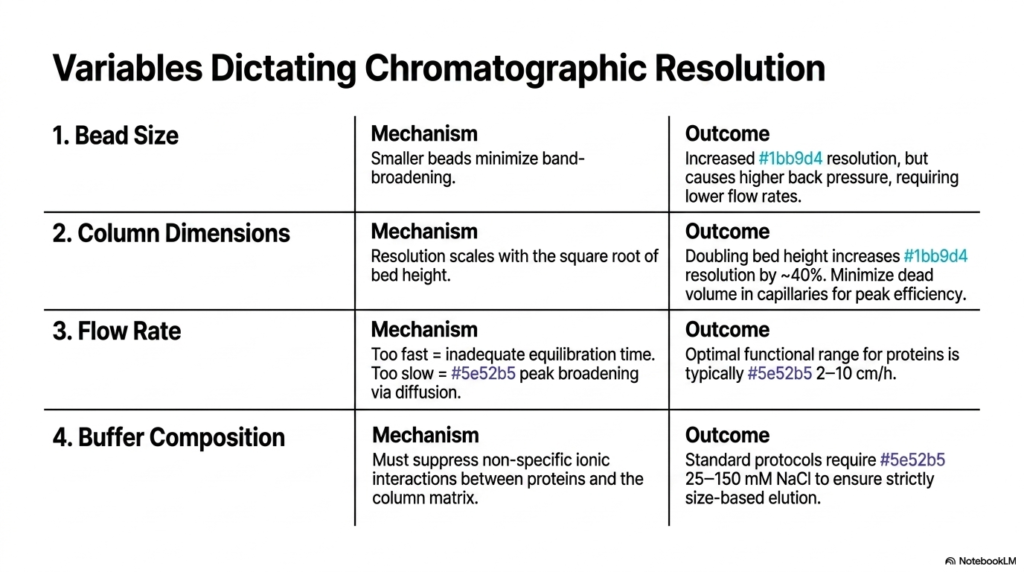
Safely driving a high-performance sports car strictly requires flawlessly managing speed, exact tire pressure, and precise steering entirely simultaneously; successful chromatography requires the exact same multifaceted, highly intense control. The core purpose of this slide is to meticulously break down the four primary variables that actively dictate precise chromatographic resolution. For students mastering Protein Isolation and Purification, accurately manipulating these specific physical and chemical parameters is the definitive key to transforming a messy chromatogram into distinct, beautiful peaks.
The absolutely first critical variable is precise bead size. Smaller, highly uniform beads mathematically minimize undesirable physical band broadening, thereby directly increasing overall resolution. However, this microscopic perfection definitely comes at a macroscopic mechanical cost: smaller beads immediately cause much higher equipment backpressure, thereby requiring much lower flow rates. The second variable distinctly involves column dimensions. Resolution mathematically scales precisely with the square root of the total bed height in any Protein Isolation and Purification setup.
Precise flow rate operates as the highly sensitive third vital variable. If the liquid buffer moves too quickly, there is insufficient time for equilibration for the large molecules to properly enter the tiny pores. If the liquid moves too slowly, the molecular peaks broaden violently due to simple, passive diffusion. The optimal functional kinetic range for pristine Protein Isolation and Purification is heavily restricted to a mere two to ten centimeters per hour, requiring immense operational patience.
Finally, the chemical buffer composition must be aggressively and flawlessly controlled. The dynamic mobile phase must completely suppress all nonspecific ionic interactions between the charged target proteins and the inert column matrix. Standard, highly rigorous Protein Isolation and Purification protocols completely mandate the strict inclusion of twenty-five to one hundred fifty millimolar sodium chloride. This critical salt addition completely masks unwanted molecular charges, reliably ensuring perfectly smooth, size-based elution.
10. Protein Isolation and Purification: Chemical Denaturation – Unfolding the Native State
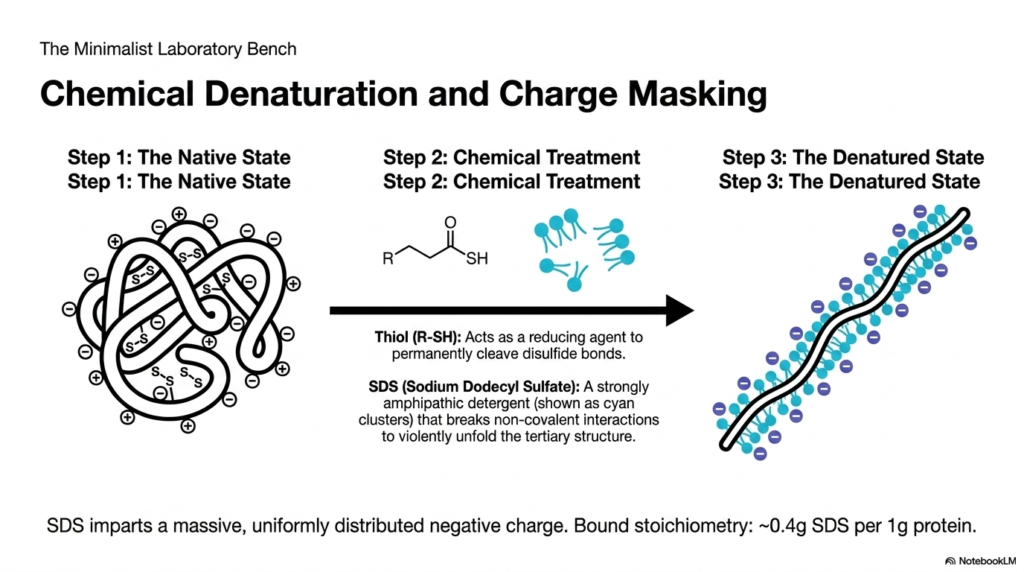
Consider taking a beautifully tangled, highly complex ball of yarn and violently pulling it completely straight into a single, perfectly uniform line. This dramatic, irreversible physical transformation is exactly what intense chemical denaturation achieves at the molecular level. The core purpose of this slide is to show how researchers intentionally and aggressively disrupt a molecule’s intricate three-dimensional structure to precisely prepare it for mass analysis. In Protein Isolation and Purification, this step is absolutely mandatory.
The visual journey begins with a highly folded, fully biologically active native-state protein, securely held together by numerous delicate noncovalent interactions and strong covalent disulfide bridges. The very first step of aggressive chemical treatment involves the complete introduction of a strong reducing agent, typically a potent thiol, to permanently and cleanly cleave these tough covalent bonds. For students heavily analyzing the absolute outcomes of Protein Isolation and Purification, understanding this initial aggressive reduction step is mechanistically crucial.
The incredibly aggressive second chemical strike fundamentally utilizes Sodium Dodecyl Sulfate, a highly potent, strongly amphipathic detergent. The aggressive hydrophobic tails of SDS molecules forcefully invade the protein’s protected core, violently disrupting all internal noncovalent interactions and forcing the entire tertiary structure to unfold into a massive linear chain. This aggressive unfolding is an absolutely definitive hallmark technique in the final analytical evaluation phase of any serious Protein Isolation and Purification protocol.
Crucially, the aggressive SDS does significantly more than simply unfold the target molecule; it actively imparts a massive, uniformly distributed negative charge along the entire length of the newly linear chain. The bound chemical stoichiometry is incredibly precise, reliably binding 0.4 grams of SDS per gram of protein. This brilliant chemical manipulation ensures that the final denatured state is completely primed for the next vital Protein Isolation and Purification step.
11. Protein Isolation and Purification: Electrophoretic Separation – Sifting by Linear Mass
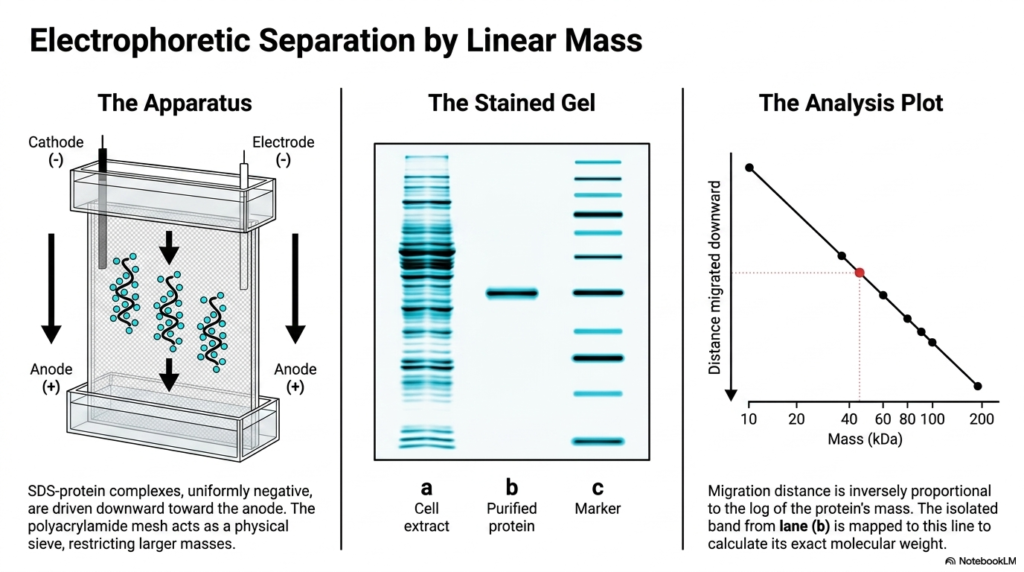
When observing different-sized rocks dropped through a highly dense thicket of physical branches, the absolute smallest pebbles inevitably and quickly hit the solid ground first. Analytical gel electrophoresis fundamentally utilizes a highly controlled, strongly electrically driven version of this exact physical phenomenon. The core purpose of this slide is to thoroughly explain electrophoretic separation strictly by linear mass, the completely definitive analytical technique used to verify the absolute success of any complex Protein Isolation and Purification pipeline.
The detailed apparatus visually brilliantly demonstrates the fundamental biophysics actively at play. The uniformly negative, highly charged SDS-protein complexes, meticulously prepared in the previous aggressive denaturation step, are forcefully and continuously driven downward strictly from the negative cathode precisely toward the positive anode. Meanwhile, the dense polyacrylamide mesh reliably serves as a microscopic physical sieve, actively and strongly restricting the rapid migration of significantly larger molecular masses, thereby enabling Protein Isolation and Purification to be analytically verified.
The darkly stained gel image, positioned squarely in the center, serves as the ultimate scientific report card for any dedicated biochemist. Lane ‘a’ thoroughly showcases a visually messy, highly chaotic cell extract, definitively confirming the immense molecular complexity of the initial raw biological sample. Lane ‘b’, however, brilliantly reveals a single, beautiful, highly crisp molecular band. This visual absolute confirmation of extreme purity is the triumphant goal of all Protein Isolation and Purification campaigns.
The mathematical analysis plot, securely positioned on the right, brilliantly and permanently bridges the vital gap strictly between qualitative visual bands and hard quantitative data. The migration distance of any given molecular band is directly proportional to the logarithm of the protein’s exact mass. By meticulously mapping the successfully isolated band from lane ‘b’ directly against the known analytical standards, researchers can definitively conclude their entire Protein Isolation and Purification workflow.
12. Protein Isolation and Purification: Connecting Properties to Techniques – The Master Synthesis
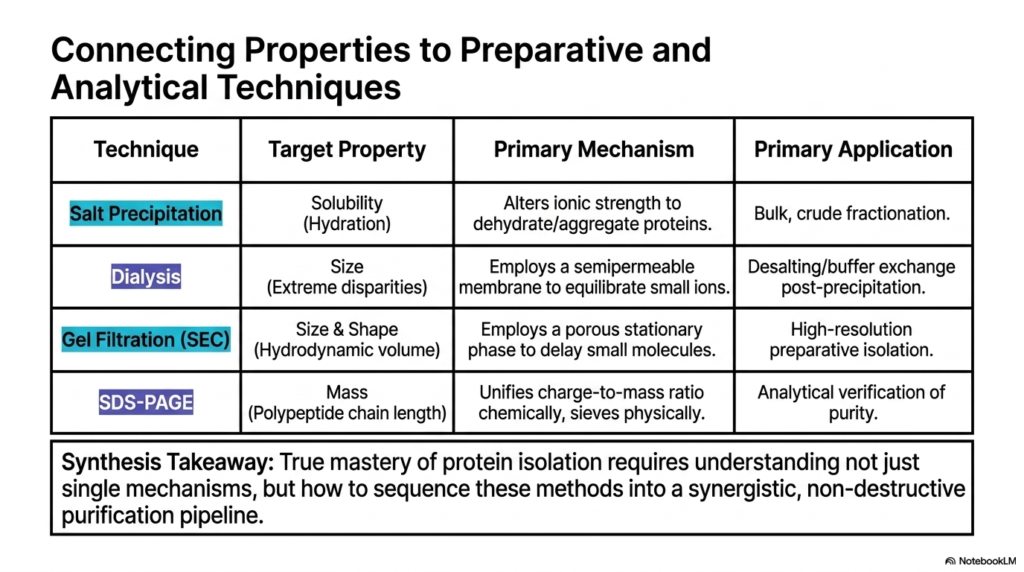
Attempting to aggressively build a sturdy, permanent house using only a basic hammer might drive a few nails, but the entire structure will eventually collapse. True scientific craftsmanship strictly requires deploying a complete toolkit, brilliantly applied in the exact correct sequence. The core purpose of this final slide is to definitively connect distinct molecular properties directly to their specific preparative techniques, serving as the master synthesis for Protein Isolation and Purification.
The highly comprehensive synthesis table beautifully and rigorously categorizes the four major biochemical techniques discussed throughout the presentation. Salt precipitation aggressively exploits fundamental solubility for bulk, highly crude preliminary fractionation. Dialysis effectively targets extreme physical size disparities to entirely passively exchange harsh buffers post-precipitation. Gel filtration fully leverages precise hydrodynamic volume to achieve ultra-high-resolution isolation. Finally, SDS-PAGE determines the exact chain length for analytical verification of Protein Isolation and Purification.
A thorough understanding of isolated mechanisms is absolutely insufficient for success in modern biochemical laboratories. The vital synthesis takeaway, positioned at the very bottom, strictly dictates that true analytical mastery requires thoroughly sequencing these distinct methods into a highly synergistic, completely non-destructive pipeline. A researcher absolutely cannot simply apply delicate high-resolution chromatography directly to a messy crude cellular lysate; the strict logic of Protein Isolation and Purification absolutely demands perfect sequential progression.
By deeply internalizing this comprehensive, logical framework, dedicated college and medical school students successfully transition from basic rote memorization to rigorous scientific application. They thoroughly learn to aggressively view a highly complex, heavily mixed biological sample strictly as a strategic, logical puzzle. This holistic, masterful understanding of Protein Isolation and Purification confidently empowers the next generation of brilliant biochemists to reliably isolate the fundamental molecules that drive life.
Please read our Content Disclaimer Statement.
Check out our social media channels: